
Most of the software I use every day wasn't built here. The tools I learned programming with weren't built here. Most of the software students use for notes, productivity, research, and learning wasn't built here either.
That's fine. I just don't think it has to stay that way.
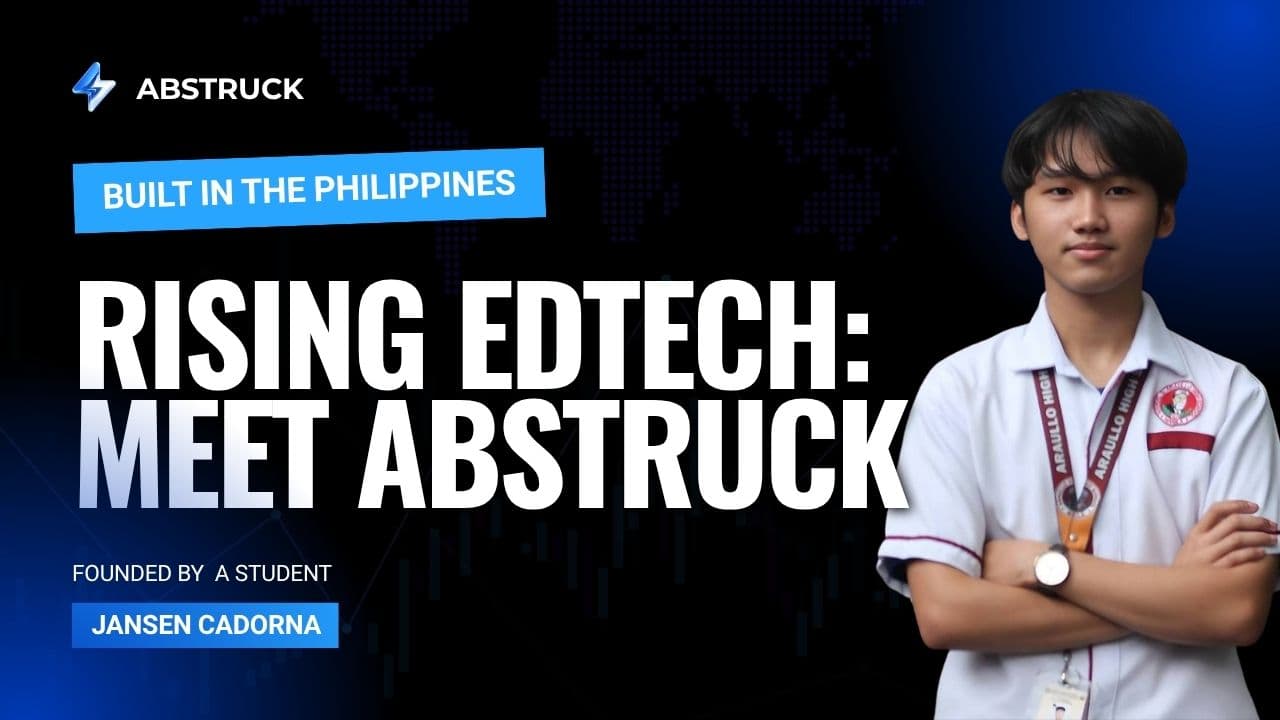
I'm building Abstruck from the Philippines, and one thing I've become increasingly sure about is that I don't want "Filipino-built" to come with some automatic expectation that the product has to think locally, compete locally, or stay small. It can start here and still be built for anyone. That's the plan.
Starting here was never the problem
There's this weird habit we have of treating geography like a qualification. A startup coming out of San Francisco sounds normal. A new software company from New York, London, Singapore, or Berlin doesn't really need to explain itself.
Then you say you're an 18-year-old student building an EdTech company from the Philippines and suddenly the location becomes part of the story.
I get why. I'm proud that Abstruck is being built here. But I don't want that pride to turn into an excuse. I don't want Abstruck to be "good for a Filipino startup." I want it to be good. That's a much harder standard, which is probably why I like it.
There are already Filipino founders, developers, researchers, and technology companies doing serious work here. Philippine EdTech isn't some imaginary category we're waiting for permission to create. The Department of Science and Technology has supported homegrown education technology companies such as WELA School Systems, and programs from DOST and CHED are actively putting resources behind student entrepreneurship and commercialization.
So no, the Philippines is not incapable of producing technology companies. We probably just need more people stubborn enough to keep trying. I'm volunteering.
Abstruck started because I was already living the problem
I'm still a student. Which means I'm surrounded by information almost constantly.
Lectures. Recordings. Documents. Videos. Notes. Links I saved because I was absolutely going to read them later. I was not.
And the more information I collected, the more obvious the problem became. Having information somewhere isn't the same as knowing it.
A one-hour lecture sitting in a folder is technically information you own. A 40-page document you haven't touched since downloading it is technically accessible. A useful explanation buried inside an old conversation technically still exists. None of that means you're ever going to find it again when you need it.
That's the problem I became interested in. Not simply storing more things. Not generating more things. Actually turning information into something useful. Something you can understand. Organize. Return to. Question. Remember. Use.
That became the foundation for Abstruck.
At first, I thought I was building something much smaller
The early idea revolved heavily around recordings. Take a lecture or another recording, transcribe it, and make the information easier to work with. Straightforward enough.
Then I kept building. Searchable transcripts. Timestamps. Summaries. Notes. Flashcards. Questions grounded in the original material. A place for everything to stay connected instead of disappearing after one interaction.
Eventually I had to admit that I wasn't really interested in building a transcription tool anymore. Transcription was just one way information entered the system. The more interesting part was everything that happened after.
That changed how I started thinking about Abstruck.
Today, I'm building it as a learning and knowledge workspace: a place designed around taking information and turning it into knowledge you can actually use. You can see more of what we're building on the Abstruck features page.
There are much bigger companies working somewhere around this space. I've looked at them. Probably too much.
Competing with bigger companies is actually pretty useful
When you're building alone, your product can look impressive very quickly. You finish a feature. It works. You open localhost and stare at it for a while. Great.
Then you open five competitors with larger teams, years of development, funding, distribution, and more features than you reasonably have time to count.
Character building.
For a while, competitor research messed with me badly. Everything someone else had became something I felt like Abstruck was missing. If another platform supported something, I wanted to support it. If their feature list was longer, mine suddenly felt incomplete. I was basically using market research as an advanced method of ruining my own confidence.
Eventually that stopped being useful. Because if Abstruck's strategy is just:
see what larger company built → build smaller version
then there isn't much of a company there. There definitely isn't a reason for anyone to switch.
So instead of asking how many features everyone else had, I started asking a more annoying question:
What should Abstruck understand better than them?
For me, the answer kept coming back to the same thing. Information becoming usable knowledge. That's the lens now. It doesn't mean every feature has to be unique. That's unrealistic. It means every feature needs to make sense inside the product we're actually trying to build.
That distinction saved me from building a lot of nonsense. Probably not all of it. I'm still learning.
Being a student founder is inconveniently useful
There are obvious disadvantages to building a software startup at 18. I do not have decades of experience. There are business decisions I'm making for the first time. There are entire parts of building a company that I've had to learn because apparently nobody arrives to do them for you.
Engineering was familiar. Then suddenly I also needed to understand product strategy. Design. Infrastructure. AI systems. Pricing. SEO. Analytics. Marketing. Positioning. Distribution. Legal questions. Customer experience. The list gets disrespectfully long.
But being a student building education technology also means I don't have to manufacture an idea of what using these products feels like. I use them. I'm around the people who use them. I know what it's like to have ten things due, six tabs open, a recording you haven't reviewed, notes scattered everywhere, and absolutely no desire to introduce another complicated piece of software into the situation.
That keeps me fairly intolerant of features that are impressive but annoying. If something adds more work than it removes, I notice. If the product starts looking like it's being built for a pitch deck instead of an actual student, I notice that too.
That doesn't mean every student will want exactly what I want. It does mean the problem stays close. I think that's useful.
Why building from the Philippines matters to me
I don't want to build Abstruck around nationalism. Software doesn't become better because of where the founder was born.
But I do care about what it represents.
The Philippines has spent decades being extremely good at supplying talent to other people's companies. Developers. Designers. Engineers. Support teams. Creatives. Operators. We already know Filipinos can contribute to world-class products. I'd like to see more of those products originate here too.
More intellectual property created here. More software brands created here. More founders here who don't immediately treat an international market as something reserved for somebody else.
I don't expect that to happen because we post about supporting local startups. The products still have to compete. That's the important part.
If Abstruck is slower, worse, less useful, or poorly designed, nobody outside the Philippines is obligated to care that a Filipino student built it. Good. I'd rather compete under that rule.
The Philippine part is where we started. It isn't the ceiling.
What we're actually trying to build
The simplest way I can explain Abstruck is this:
Information should become usable knowledge.
That's it.
We're starting with the ways students already encounter information and building tools around understanding, organizing, remembering, retrieving, and using it. Today that includes things like recordings, searchable transcripts, summaries, notes, flashcards, source-grounded questions, and a personal knowledge workspace.
And there's a lot more I want to explore over time.
But I'm trying to be careful about one thing: I don't want Abstruck to become a pile of features with an AI label attached to it. There are enough products doing that. The goal is a coherent workspace where the things you've learned don't immediately become digital clutter.
Something you can come back to. Something that remembers where information came from. Something that helps make what you've consumed useful again.
That's a significantly harder product to build than the original idea I started with. Naturally, I decided to keep going.
We have a lot to prove
I don't want to write one of those startup posts where everything is apparently going perfectly. It isn't.
Abstruck is competing in a crowded market. I'm still learning constantly. There are decisions I'll probably look back on in a year and wonder what I was thinking. There are companies with far more resources than I have. There is absolutely no guarantee that building something ambitious means it works.
That's not really a reason to make the ambition smaller.
The part I control is whether I keep improving the product. Whether I understand the problem better. Whether I listen when something isn't working. Whether I keep learning things I currently don't know. Whether the version of Abstruck six months from now makes today's version look unfinished.
That's enough for me to work with.
I'm 18. I'm building from the Philippines. There are easier things I could probably be doing with my time. But I know what I'm capable of now, and unfortunately that has made me considerably harder to convince to stop.
So we'll keep building.
Not the Philippine version of somebody else's product. Not something that's impressive for a student. Just something we believe deserves to compete.
Built here. Built to compete anywhere.
Abstruck is a Filipino-built learning and knowledge workspace designed to turn information into knowledge you can understand, organize, retrieve, and use.